Does Your Razor Cause More Razor Bumps? What Black Men Should Know
May 15th 2026
Three blades, four blades, or five blades? And still the same bumps every Monday morning. If that sounds familiar, you are not alone. Razor bumps affect a large share of Black men who shave regularly. The bumps show up on the neck, jawline, and chin. They hurt. They leave dark spots. And most men just keep buying new razors, hoping the next one fixes things.
It does not. Here is why.
Razor bumps are not a product problem. They are a biology problem. And once you understand the biology, stopping them naturally becomes straightforward. This guide covers the real cause, the right shaving routine, and the natural remedies that actually work.
Why Razor Bumps Hit Black Men Harder
The medical name for razor bumps is pseudofolliculitis barbae (PFB). The American Osteopathic College of Dermatology reports that PFB affects up to 83 percent of Black men who shave, compared to a much lower rate in men with straight hair.
Let's break it down.
Black men naturally have tightly coiled facial hair follicles. When you cut that coiled hair, the sharp tip curls as it grows. Instead of growing straight out of the skin, it curves back and re-enters the follicle or pierces the surrounding skin. The skin treats them like a foreign object. It sends an immune response. That response creates the redness, swelling, and painful bumps you see in the mirror.
Shaving too close makes this worse. Multi-blade razors cut below the skin surface, leaving a hair tip that is sharp and subsurface. When it grows back, it has almost no room before it starts curling inward. The more you shave without addressing the root cause, the more your skin keeps fighting itself.
Is Your Razor Actually Making Things Worse?
This is where most men go wrong. Multi-blade razors are marketed as giving a closer shave. That is technically true. But a closer shave is exactly what causes more ingrown hairs in curly beard hair.
Each blade in a multi-blade cartridge lifts the hair slightly before cutting. The next blade cuts it even lower, sometimes below the skin surface. For straight hair, this is fine. For tightly coiled hair, this creates a subsurface hair tip that has nowhere to grow except back into the surrounding tissue.
Use a Single-Blade Safety Razor
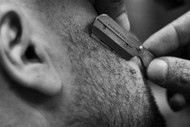
A single-blade safety razor cuts at the skin surface, not below it. The hair tip stays above the follicle opening, which gives it a clear path to grow outward instead of inward.
Consider an electric trimmer for sensitive skin days.
Electric trimmers and foil shavers leave a small amount of stubble rather than cutting at skin level. This stubble gap is enough to stop the hair from re-entering the follicle.
- Always shave with the grain
Follow the direction of hair growth. Shaving against the grain cuts the hair at a sharper angle, making re-entry more likely.
- Use light, short strokes
Pressing too hard drags more skin into the blade path and increases irritation in already sensitive follicles.
- Rinse the blade after every stroke
Built-up lather and cut hair force you to press harder on the next pass.
- Make only one pass over each area
Multiple passes on the same spot strip the protective skin layer and irritate it.
Your Natural Razor Bump Prevention Routine, Step by Step
- The night before shaving
Exfoliate gently with a brown sugar scrub or soft washcloth. Moisturize with coconut oil before bed.
- Morning of shave
Wash face with warm water for 60 seconds. Press a warm towel against the beard area for two minutes.
- Shaving
Use a single-blade safety razor. Shave with the grain only. Short, light strokes. One pass per area. Rinse the blade after each stroke.
- Immediately after
Rinse with cool water. Gently pat dry with a clean towel. Do not rub.
- Aftercare
Apply alcohol-free witch hazel with a cotton pad. Wait five minutes. Apply a thin layer of aloe vera gel. Let it absorb. Seal with a small amount of coconut oil.
Conclusion
Razor bumps are not just about shaving too often. The wrong razor and poor shaving habits can make them worse. Black men with curly facial hair need a routine that protects the skin and helps hair grow outward naturally. Simple changes like using a single-blade razor and gentle aftercare can reduce bumps and irritation.
Frequently Asked Questions
Why do Black men get more razor bumps?
Black men often have tightly curled facial hair that naturally grows back into the skin after shaving, causing ingrown hairs and inflammation.
Are multi-blade razors bad for razor bumps?
Multi-blade razors can worsen razor bumps because they cut hair below the skin surface, increasing the chance of hair curling inward.
What is the best razor for preventing razor bumps?
A single-blade safety razor or an electric trimmer is usually better because it leaves hair slightly above the skin, reducing ingrown hairs.